New Immigrant Self-Employed Mortgage Programs in Toronto: Qualifying with Foreign Business History in 2026
New Immigrant Self-Employed Mortgage Programs in Toronto: Qualifying with Foreign Business History in 2026
Starting a new life in Toronto as a self-employed entrepreneur brings exciting opportunities—but securing a mortgage can feel like navigating a maze. For new immigrants with established businesses overseas, the challenge intensifies: How do Canadian lenders evaluate foreign business history? Can international success translate into mortgage approval? In 2026, New Immigrant Self-Employed Mortgage Programs in Toronto: Qualifying with Foreign Business History in 2026 offer specialized pathways that recognize overseas entrepreneurial experience, making homeownership more accessible than ever before.
The landscape has evolved significantly. Major mortgage insurers and lenders now provide tailored solutions that acknowledge the unique position of newcomers who've built successful businesses abroad but lack Canadian credit history or tax returns. Understanding these programs can mean the difference between renting indefinitely and building equity in Canada's largest city.
Key Takeaways
✅ Specialized mortgage programs allow new immigrants to qualify with as little as 3 months of Canadian employment history, even when self-employed [1]
✅ Down payments as low as 5% are available through CMHC, Sagen, and Canada Guaranty programs designed specifically for newcomers [4]
✅ Foreign business documentation can substitute for traditional Canadian tax returns when properly translated and verified by approved lenders
✅ Work permits or permanent residency obtained within 5 years qualify applicants for newcomer mortgage programs with flexible requirements [3]
✅ Alternative income verification methods recognize international business success through bank statements, contracts, and overseas financial records
Understanding New Immigrant Self-Employed Mortgage Programs in Toronto
What Makes These Programs Different?
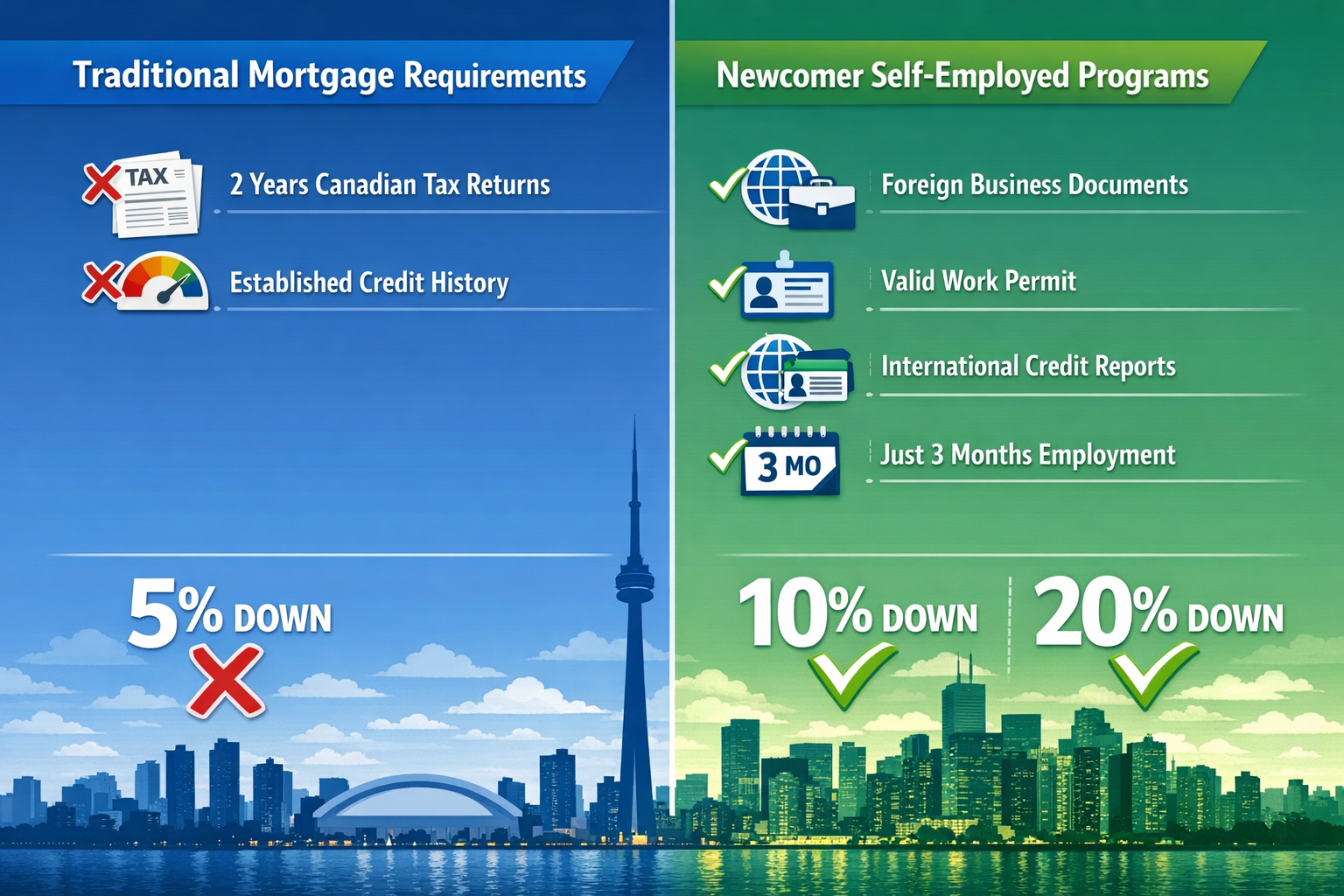
Traditional Canadian mortgage qualification requires two years of Canadian tax returns for self-employed borrowers—an impossible standard for recent arrivals. New immigrant self-employed mortgage programs break this mold by accepting alternative documentation that proves income stability and business viability.
These specialized programs recognize that successful entrepreneurs don't lose their skills when crossing borders. A business owner who operated profitably in India, China, Nigeria, or anywhere else brings valuable experience and earning potential to Canada.
Key program features include:
- 📋 Acceptance of foreign business financial statements
- 🏦 Reduced Canadian employment history requirements (minimum 3 months) [1]
- 💰 Lower down payment thresholds (5-20% depending on property value) [4]
- 📊 Alternative credit assessment using international credit reports
- ✅ Flexible income verification through multiple documentation sources
Major Insurers Offering Newcomer Programs
Three primary mortgage default insurance providers serve the Canadian market, each offering newcomer-specific solutions:
| Insurer | Program Name | Minimum Time in Canada | Key Features |
|---|---|---|---|
| CMHC | Newcomers Program | Varies by lender | 5% down payment, flexible documentation [4] |
| Sagen | New to Canada | 3 months full-time employment | Accepts foreign credit history [1] |
| Canada Guaranty | Maple Leaf Advantage | 3 months employment | International credential recognition [2] |
These programs work with approved lenders across Toronto, including major banks and mortgage brokers specializing in newcomer financing.
Qualifying with Foreign Business History: Documentation Requirements
Translating International Business Credentials
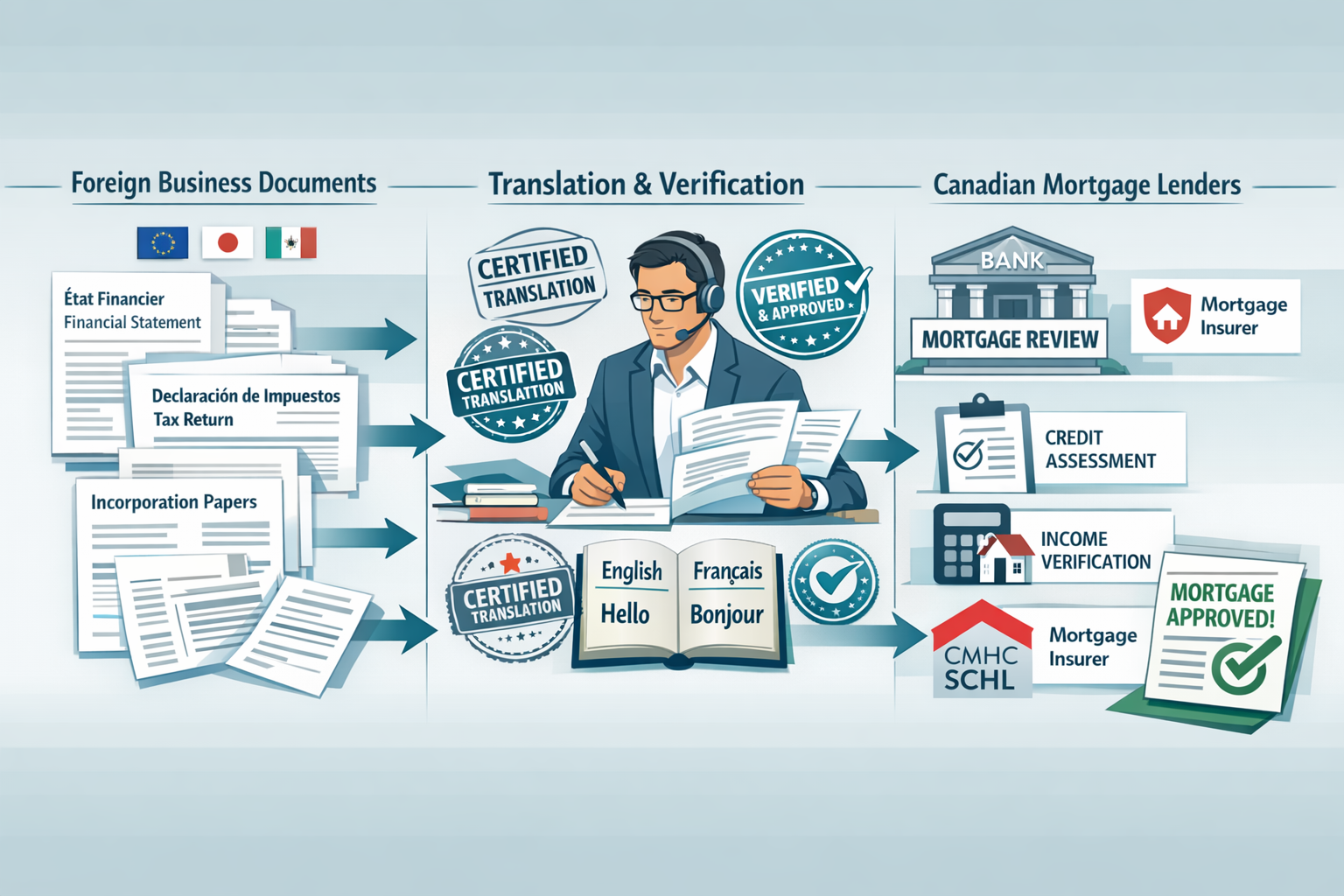
The cornerstone of New Immigrant Self-Employed Mortgage Programs in Toronto: Qualifying with Foreign Business History in 2026 lies in proper credential translation. Canadian lenders cannot assess documents in foreign languages without certified translations.
Essential documentation includes:
Business Registration Documents
- Articles of incorporation or business licenses
- Partnership agreements or sole proprietorship registrations
- Professional licenses or trade certifications
Financial Statements
- Profit and loss statements (minimum 2 years)
- Balance sheets showing business assets
- Bank statements demonstrating cash flow
- Tax returns from country of origin
Income Verification
- Client contracts or invoices
- Payment receipts showing consistent income
- Letters from accountants or financial advisors
- Business bank account statements
Certified Translation Services
Lenders require translations from certified professional translators recognized by Canadian immigration authorities. These services typically cost $50-150 per page depending on language complexity and document length.
"Proper translation of foreign business documents is non-negotiable. Lenders need to understand your business model, revenue streams, and financial stability in clear English or French." — Toronto Mortgage Specialist
Translation must include:
- Translator's certification and credentials
- Original language document attached
- Seal or stamp from translation service
- Date of translation
How Lenders Assess International Business Experience
Canadian mortgage underwriters evaluate foreign business history through several lenses:
Business Continuity: Can the business model transfer to Canada? A software consultant or e-commerce entrepreneur may find easier acceptance than someone in region-specific industries.
Income Stability: Lenders look for consistent revenue over time, not just recent spikes. Two years of steady income carries more weight than one exceptional year.
Industry Transferability: Professional credentials that translate across borders (accountants, engineers, IT specialists) receive favorable consideration.
Canadian Establishment: Evidence of business setup in Canada—even preliminary steps like business registration, client acquisition, or workspace rental—strengthens applications significantly.
Eligibility Criteria for Self-Employed Newcomers in 2026
Immigration Status Requirements
To access New Immigrant Self-Employed Mortgage Programs in Toronto: Qualifying with Foreign Business History in 2026, applicants must meet specific immigration criteria:
Acceptable immigration status includes:
✅ Permanent residents (landed within past 5 years) [3]
✅ Valid work permit holders with minimum 12 months remaining
✅ Study permit holders with off-campus work authorization (limited programs)
✅ Protected persons or convention refugees with valid documentation
TD Canada Trust and other major lenders typically require that permanent residency or work permits were obtained within the last 5 years to qualify for newcomer programs [3]. This timeframe ensures programs serve recently arrived immigrants rather than long-established residents.
Minimum Canadian Employment History
One of the most significant advantages of newcomer programs is the reduced employment history requirement. Both Sagen's New to Canada Program and Canada Guaranty's Maple Leaf Advantage require just 3 months of full-time employment in Canada [1][2].
For self-employed applicants, this means:
- 3 months of documented business activity in Canada
- Consistent income generation during this period
- Evidence of client relationships or contracts
- Business bank account statements showing transactions
This represents a dramatic reduction from the standard 2-year requirement for traditional self-employed mortgages.
Down Payment Requirements
Down payment thresholds vary based on property purchase price:
Purchase Price Under $500,000:
- Minimum 5% down payment available [4]
- Full mortgage insurance required
- Ideal for first-time buyers in Toronto's condo market
Purchase Price $500,000 - $999,999:
- 5% on first $500,000
- 10% on remaining amount
- Common scenario for Toronto townhomes and smaller detached homes
Purchase Price $1,000,000+:
- Minimum 20% down payment required
- No mortgage insurance available
- Conventional mortgage rules apply
Many self-employed newcomers leverage savings from their home country for down payments. Lenders accept gift funds from family members with proper documentation, expanding purchasing power.
Credit History Considerations
Traditional Canadian credit scores (FICO or Equifax) don't exist for recent arrivals. Newcomer programs address this through:
📱 Alternative Credit Data:
- International credit reports from home country
- Rental payment history in Canada
- Utility bill payment records
- Mobile phone payment history
🏦 Banking Relationship:
- Canadian bank account statements (minimum 3-6 months)
- Savings account balances
- No NSF (non-sufficient funds) incidents
- Regular deposit patterns
🔍 Reference Letters:
- Previous landlord references
- Professional references in Canada
- Business client testimonials
- Letters from financial institutions
Navigating the Application Process: Step-by-Step Guide
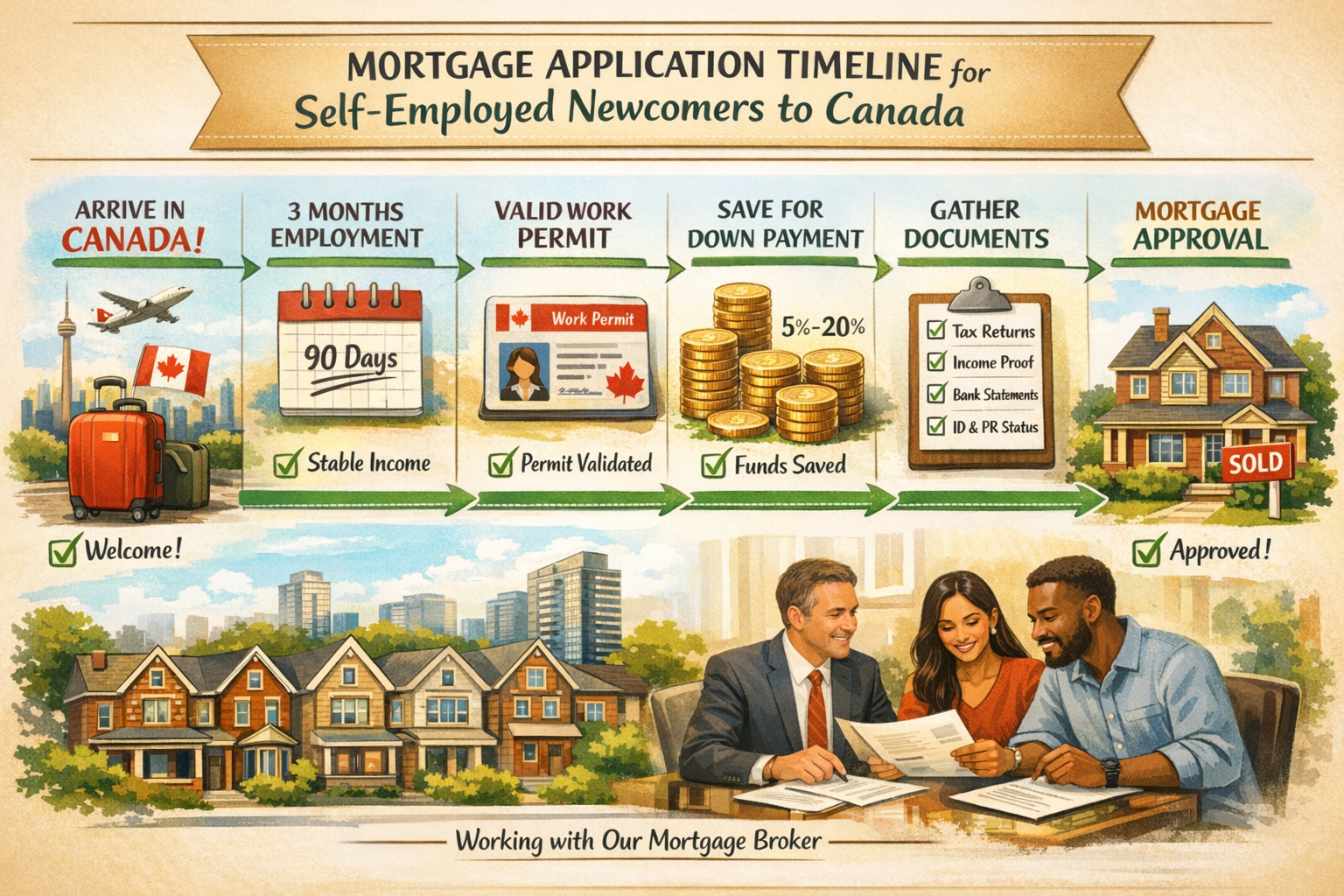
Step 1: Assess Your Qualification Timeline
Before applying for New Immigrant Self-Employed Mortgage Programs in Toronto: Qualifying with Foreign Business History in 2026, create a realistic timeline:
Month 1-3: Establish Canadian business presence
- Register business with provincial authorities
- Open business bank account
- Begin generating Canadian income
- Secure initial clients or contracts
Month 3-6: Build documentation
- Gather foreign business records
- Arrange certified translations
- Compile 3+ months Canadian income proof
- Establish banking relationship
Month 6+: Prepare mortgage application
- Work with mortgage broker specializing in newcomers
- Pre-qualify for specific loan amounts
- Identify suitable properties within budget
- Finalize down payment sources
Step 2: Choose the Right Lender or Broker
Not all lenders offer equal expertise with newcomer self-employed mortgages. Consider:
Mortgage Brokers Specializing in Newcomers:
- Access to multiple lender programs
- Experience with foreign documentation
- Understanding of cultural nuances
- Often multilingual services
Major Banks with Newcomer Programs:
- TD Canada Trust [3]
- RBC Royal Bank
- Scotiabank
- CIBC
- BMO Bank of Montreal
Credit Unions:
- More flexible underwriting
- Relationship-based lending
- Potentially higher interest rates
- Smaller loan amounts
Step 3: Prepare Your Documentation Package
A complete application includes:
Immigration Documents:
- Permanent resident card or work permit
- Passport and entry stamps
- Immigration approval letters
Business Documentation:
- Canadian business registration
- Foreign business financial statements (translated)
- Business bank statements (3-24 months)
- Client contracts or invoices
- Professional licenses or certifications
Personal Financial Records:
- Personal bank statements (6 months minimum)
- Down payment source documentation
- Gift letters if applicable
- International credit reports
Property Information:
- Purchase agreement
- Property listing details
- Home inspection report
- Property tax assessment
Step 4: Understand Approval Conditions
Newcomer self-employed mortgages often come with specific conditions:
⚠️ Higher Interest Rates: Expect rates 0.25-0.75% above standard mortgage rates due to perceived risk
⚠️ Mortgage Insurance Premiums: Required for down payments under 20%, ranging from 2.8-4.0% of loan amount [4]
⚠️ Larger Down Payments Preferred: While 5% minimums exist, 10-20% down payments improve approval odds and reduce costs
⚠️ Debt Service Ratios: Gross Debt Service (GDS) should stay below 32%, Total Debt Service (TDS) below 40%
Overcoming Common Challenges and Obstacles
Challenge 1: Proving Income Consistency
Problem: Self-employed income fluctuates, making consistent income proof difficult.
Solutions:
- Average income over 2-year period from foreign business
- Show upward income trend rather than flat consistency
- Provide signed contracts for future Canadian work
- Demonstrate diversified client base reducing risk
- Include retainer agreements or recurring revenue models
Challenge 2: Limited Canadian Credit History
Problem: No Canadian credit score exists for recent immigrants.
Solutions:
- Obtain secured credit card immediately upon arrival
- Become authorized user on spouse's Canadian credit card
- Use credit-building programs offered by major banks
- Provide international credit reports with translations
- Demonstrate 12+ months of perfect rent payments
Challenge 3: Industry-Specific Concerns
Problem: Some business types face additional scrutiny.
High-Risk Industries:
- Real estate agents (commission-based)
- Restaurant owners (high failure rate)
- Construction contractors (seasonal income)
- Retail businesses (market dependent)
Solutions:
- Provide larger down payments (15-20%)
- Show exceptional foreign business track record
- Demonstrate Canadian business traction quickly
- Consider co-signers with established Canadian credit
- Work with specialized lenders familiar with your industry
Challenge 4: Property Type Restrictions
Problem: Not all property types qualify under newcomer programs.
Generally Accepted:
- Single-family detached homes
- Semi-detached houses
- Townhouses
- Condominiums (with conditions)
Often Restricted:
- Investment properties (must be primary residence)
- Properties requiring major renovations
- Rural properties or large acreages
- Multi-unit residential buildings
Toronto-Specific Considerations for 2026
Market Conditions and Pricing
Toronto's real estate market in 2026 continues to present both opportunities and challenges for newcomers:
Average Home Prices (Q1 2026):
- Detached homes: $1.3-1.8 million
- Semi-detached: $900,000-1.2 million
- Townhouses: $700,000-950,000
- Condominiums: $550,000-750,000
These prices make the 5% minimum down payment option particularly valuable for condo purchases, where $27,500-37,500 can secure entry into homeownership [4].
Neighborhood Targeting for Newcomers
Self-employed newcomers often gravitate toward specific Toronto areas:
Scarborough: Diverse community, relatively affordable, strong newcomer networks
North York: Excellent transit access, varied housing stock, established immigrant communities
Mississauga/Brampton: Suburban alternatives with lower entry prices, growing business opportunities
Downtown Condos: Proximity to clients, networking opportunities, rental income potential
Transit and Business Accessibility
For self-employed individuals, location impacts business viability:
- Proximity to TTC subway lines for client meetings
- Access to co-working spaces in downtown core
- Nearness to industry clusters (tech in Waterfront, finance in Financial District)
- Home office space requirements and zoning considerations
Maximizing Your Approval Chances: Expert Tips

Build Canadian Business Presence Quickly
The faster you establish legitimate business operations in Canada, the stronger your mortgage application:
- Register Your Business Immediately: Sole proprietorship, partnership, or incorporation
- Open Business Bank Account: Separate from personal finances
- Secure Canadian Clients: Even small contracts demonstrate market viability
- Join Professional Associations: Industry credibility and networking
- Obtain Required Licenses: Professional designations or trade licenses
Leverage Your Foreign Success Story
Frame your international business history as an asset:
"Don't just submit documents—tell your business story. Explain how your overseas success translates to Canadian market opportunities. Lenders want to understand the person behind the paperwork."
Create a business narrative document that includes:
- Company history and growth trajectory
- Major achievements and milestones
- Transferable skills and expertise
- Canadian market research and business plan
- Existing Canadian connections or clients
Work with Specialized Professionals
Assemble a team experienced in newcomer financing:
Mortgage Broker: Specializing in self-employed and newcomer mortgages
Accountant: Familiar with international tax issues and Canadian business setup
Immigration Lawyer: Ensuring work permits or PR status remain valid
Real Estate Agent: Understanding newcomer needs and budget constraints
Translator: Certified for financial document translation
Consider Alternative Lender Options
If traditional banks decline your application, explore:
B-Lenders (Alternative Lenders):
- More flexible underwriting standards
- Higher interest rates (typically 1-3% above prime)
- Shorter term lengths (1-3 years)
- Bridge to traditional financing later
Private Lenders:
- Asset-based lending (property value focus)
- Significantly higher rates (6-12%)
- Short-term solutions only
- Higher fees and costs
Credit Unions:
- Relationship-based decisions
- Local market knowledge
- Potentially more flexible with foreign documentation
- Competitive rates for members
Conclusion
New Immigrant Self-Employed Mortgage Programs in Toronto: Qualifying with Foreign Business History in 2026 represent a significant opportunity for entrepreneurial newcomers to achieve homeownership without waiting years to establish Canadian financial history. With minimum requirements of just 3 months of Canadian employment [1][2], down payments as low as 5% [4], and acceptance of foreign business documentation, these programs recognize the value that immigrant entrepreneurs bring to Canada's economy.
Success requires thorough preparation: gathering and translating foreign business records, establishing Canadian business presence quickly, working with specialized lenders who understand newcomer challenges, and presenting a compelling narrative that connects overseas success to Canadian opportunity.
Your Next Steps
Immediate Actions (This Month):
- ✅ Verify your immigration status qualifies (PR or work permit within 5 years) [3]
- ✅ Register your Canadian business entity
- ✅ Open Canadian business and personal bank accounts
- ✅ Begin gathering foreign business documentation for translation
Short-Term Actions (1-3 Months):
- ✅ Complete certified translations of all foreign business documents
- ✅ Accumulate 3 months of Canadian business income documentation [1][2]
- ✅ Build relationship with mortgage broker specializing in newcomers
- ✅ Research Toronto neighborhoods matching your budget and business needs
Medium-Term Actions (3-6 Months):
- ✅ Obtain mortgage pre-qualification to understand purchasing power
- ✅ Save additional funds for down payment and closing costs
- ✅ Build Canadian credit history through secured cards and bill payments
- ✅ Begin working with real estate agent to identify suitable properties
The path to homeownership as a self-employed newcomer in Toronto requires patience, preparation, and persistence—but specialized mortgage programs have made it more achievable than ever before. Your international business success can translate into Canadian homeownership with the right approach and documentation.
References
[1] New To Canada - https://www.sagen.ca/products-and-services/new-to-canada/
[2] Maple Leaf Advantage - https://www.canadaguaranty.ca/maple-leaf-advantage/
[3] Mortgages For Newcomers - https://www.td.com/ca/en/personal-banking/solutions/new-to-canada/mortgages-for-newcomers
SEO Meta Title and Description
Meta Title: New Immigrant Self-Employed Mortgages Toronto 2026
Meta Description: Qualify for Toronto mortgages with foreign business history. 3-month requirement, 5% down payment options for self-employed newcomers in 2026.
Tags
new immigrant mortgages, self-employed mortgage Toronto, foreign business history, newcomer home financing, CMHC newcomer program, Toronto real estate 2026, work permit mortgage, permanent resident financing, alternative income verification, immigrant homeownership, mortgage broker Toronto, self-employed newcomer